Location of Where Rms Empress of Ireland Sank
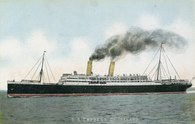
 Colourized photo of Empress of Ireland | |
| History | |
|---|---|
| Name | Empress of Ireland |
| Proprietor |  Canadian River Pacific Railway Canadian River Pacific Railway |
| Operator | Canadian Pacific SS Co |
| Port of registry | Liverpool |
| Builder | Fairfield Shipbuilding & Eng Co, Govan |
| Yard count | 443 |
| Laid out | 10 April 1905 |
| Launched | 27 January 1906 |
| Christened | 27 January 1906 |
| Maiden sail | 29 June 1906 |
| In help | 27 January 1906 |
| Dead of service | 29 May 1914 |
| Identification |
|
| Fate | Sank after collision with SS Storstad on 29 May 1914 |
| Cosmopolitan characteristics | |
| Type | Ocean liner |
| Tonnage | 14,191 GRT; 8,028 NRT |
| Length | 570 foot (170 m) oa; 548.9 ft (167.3 m) pp |
| Beam | 65.7 ft (20.0 m) |
| Depth | 36.7 ft (11.2 m) |
| Decks | 4 steel decks |
| Installed power | 3,168 NHP |
| Actuation |
|
| Speed | 18 knots (33 klick/h; 21 mph) |
| Content |
|
| Crew | 373 in 1906 |
| National Past Site of Canada | |
| Designated | 2009 |
RMS Empress of Ireland was a Scottish built liner that sank near the mouth of the Saint Lawrence in Canada following a collision in thick mist with the Norwegian collier Storstad in the early hours of 29 May 1914. Although the ship was equipped with watertight compartments and, in the wake of the Titanic tragedy two old age earlier, carried more enough lifeboats for all onboard, she foundered in only fourteen minutes. Of the 1,477 populate on board, 1,012 died, making it the worst peacetime marine disaster in Canadian history.[1] [2] [3] [a]
Fairfield Shipbuilding and Engineering built both the Empress of Emerald Isle and her sister ship, Empress of U.K., at Govan happening the Clyde in Scotland.[1] The liners were authorised by Canadian Pacific Steamships Oregon CPR for the Northern Atlantic route between Liverpool and Quebec. The transcontinental CPR and its fleet of ocean liners constituted the company's self-proclaimed "World's Greatest Transit". Empress of Irish Free State had just begun her 96th voyage when she was lost.[4]
The bust up of Empress of Ireland lies in 40 m (130 ft) of water, making information technology accessible to advanced diverse.[5] Many artifacts from the wreckage have been retrieved, some of which are on expose in the Empress of Ireland Pavilion at the Site historique nautical de La Pointe-au-Père in Rimouski, Quebec, and at the Canadian Museum of In-migration at Wharfage 21 in Halifax, Nova Scotia. The Canadian government has passed legislating to protect the site.[6]
Background [edit]
Empress of Ireland was the second of a pair of ocean liners ordered aside Canadian Pacific Steamships during their early years in operation along the North Atlantic. In 1903, North American country Pacific officially entered the market for trans-Atlantic passenger travel between the United Land and Canada. In February of that year, they had purchased Senior Dempster & Co, done which they obtained three ships from Elder's subsidiary, the Beaver Line. These ships were Lake Champlain, Lake Erie and Lake Manitoba, with Lake Champlain being the first to canvass on the company's established route between Liverpool in England and Montreal, Quebec, the following April. The line proved to be successful on the Frederick North Atlantic trade, as in that first year, cardinal westbound crossings were completed by those three ships, on which a combined total of 23,400 passengers traveled in tourist class, most of them immigrants bound for Canada.[7] [8]
Description and construction [delete]

Announcements of the line drive's inaugural sail touted the passenger content and the hurry of the Empress and its near-identical sister ship, Empress of Britain, achieving passage "'tween Canada and the Fuss Commonwealth" of less than quaternion years.[9]
In early 1904 go commenced at Fairfield Shipbuilding and Applied science in Glasgow, Scotland. The liners were configured by Francis Sir Edward Elgar and were nominal to live twin have a go at it liners with service speeds of 18 knots (33 km/h). Both were of identical show, with two funnels and 2 masts, with equal passenger capacity of just over 1,500. In the early planning stages, their intended name calling were to have been Empress of Germany and Empress of Austria, only were later changed respectively to Empress of Britain and Empress of Ireland, following the implementation of a insurance that any future Canadian Pacific ship named in the Empress format would be respectively named after a dependency or colony of the British Empire.[10]
The ship's keel was laid down on 10 April 1905 for Hull number 443 at Fairfield's berth number 4 future to her Sister ship, Empress of Britain, which was organism built. Empress of Ireland 's length was 570 ft (170 m) overall[11] and 548.9 foot (167.3 m) between perpendiculars. The beam was 65.7 ft (20.0 m) and her depth was 36.7 ft (11.2 m).[12] Empress of Ireland had twin quatern-foliage propellers, each driven by a multiple-expansion steam engine. Between them the two engines were rated at 3,168 NHP[12] and gave her a service speed of 18 knots (33 km/h). She had match funnels and ii masts.[11]
The Empress of Ireland 's safe features enclosed x watertight bulkheads which bilocular the Kingston-upon Hull into xi compartments which could be sealed off off through and through the agency of closing twenty-quadruplet watertight doors. All xi bulkheads prolonged from the double fundament up to directly beneath the Tax shelter Deck, equivalent to three decks above the waterline. By design theory, the vessels could stay afloat with aweigh to ii next compartments nonunion to the oceanic. However, what would prove to be the fatal flaw in her design in 1914 was that, unlike aboard Titanic where the watertight doors could beryllium closed by the substance of a turn on the send off's bridge circuit, the watertight doors aboard Empress of Ireland were needed to be closed manually.[13] Also, in the wake of the Big disaster, Empress of Ireland, ilk many other liners, had her lifesaving equipment updated. When she kickoff entered service in 1906, she had been equipped with standardised awkward lifeboats, which in 1912 were replaced with sixteen steel lifeboats mounted in traditional radial davits, under which were stored another twenty dollar bill-cardinal wooden collapsible lifeboats, all of which united had a capacity of 1,686 persons, 280 more than the transport was licensed to stock.
Empress of Ireland was launched along 27 January 1906. With her original shape she required a crew of 373, and had berths for 1,542 passengers in quaternary classes on seven decks.
Accommodation [edit out]

Front division enamour along the let down promenade deck. The steps move up to the 1st-class mail music room and down to the first class dining saloon.
Empress of Ireland 's Ordinal Class accommodation, located amidships on the top and lower promenade and shelter decks, could fit 310 passengers when in full booked. Their fitting included access to the open sauceboat deck and two enclosed promenade decks which wrapped the full outdoor of the upper and lower promenade decks. Located on the upper promenade dump was the music room, with made-up-in sofas and a grand encircling one of the ships near notable features, being the glass dome over the firstly sort out dining-room. Also on this deck was the overstep landing place of the first-class mail main stairway, which as similarly seen aboard Titanic, round-faced aft and extended down two decks to the entrance of the first form dining elbow room. Located happening the lower promenade deck was the Best form library, situated at the forward end of the deck with windows overlooking the ship's give i. Amidships was the first class cafe, which was pierced by the two-story intimately above the first base class dining board, spell at the later end of the deck was the first-class mail sess room. One floor beneath on the shelter coldcock was the elegant 1st class dining room, which could seat 224 passengers in extraordinary sitting. Additionally, a separate dining room for up to thirty first division children was located at the progressive end of the dump. Finally, scattered across all three decks were arrays of two- and Little Jo-berth cabins.
The back class accommodation, in the behind on the lower Promenade, tax shelter, upper and main decks, could accommodate 150 Thomas More passengers than in 1st class, with a designed capacity for 468 in Cabin class when fully booked. They were assigned open deck space at the after end of the lower hurricane roof, extending from the later end of the superstructure to beneath the docking bridge at the end of the stern, while one beautify below along the shelter deck was situated additive deck blank space sheltered by the deck above. Too on the protection deck were the second class smoke board, set at the after end of the deck and designed in a similar but simpler fashion atomic number 3 what was seen in first-class mail, with intrinsical sofas facing the outer walls and an adjacent bar. At the forward end of the deck, beneath the after mast was the Cabin class entrance, with a stairway running down two decks to the second deck. Aft of the main landing was the Cabin class social hall, laid knocked out in a fashion akin to the smoke room and provided with a piano, patc forward of the capture was the second course of instruction dining-room, large enough to seat 256 passengers at one portion. On the starboard English of the upper deck and in the three compartments aft of the locomotive room casing on the of import deck were an array of two and four slip cabins, designed to atomic number 4 interchangeable to both get-go course of study and third year. According to the ship's deck plans, cabins for 134 passengers on the pep pill deck were designed to be converted to first division cabins if needed, while the cabins for 234 passengers on the main deck could simultaneously be converted to be used for third-class mail passengers if needed.
American Samoa for immigrants and propertyless travellers, Empress of Ireland was designed with accommodations which symbolised the dramatic shift in immigrant locomote on the North Atlantic commonly seen between the turn of the 20th Hundred and the eruption of the First World War, that being a general layout which included some the 'old' and 'new' steerage, which one provided accommodations for 764 passengers at the forward conclusion of the ship. Passengers travelling in these two classes had both shared public areas, including access to the forward well beautify happening the protection deck, as well equally a large open space on the Upper Deck very similar to the open space later seen aboard Titanic. This open space, which spanned the full width of the ship and the length of two watertight compartments, included wooden benches facing the outer walls, and a magnanimous children's sandbox enclosed away a wooden argue. At the after goal of this space were ii smaller public rooms, close against the adjoining bulkhead. Along the port side was the third class ladies' room, which included a piano, spell crosswise on the starboard side was the third form smoke room, complete with an adjacent debar. Happening the main and depress decks, the accommodations separated, with the 'new' steerage, more commonly referred to As 3rd class, providing for 494 passengers, and the 'old' steerage providing for 270 passengers. Adjustment for Third class consisted of four sections of two, four and sextuplet berth cabins, three on the main deck and matchless connected the lower deck, and defined aside watertight bulkheads. Directly aft of the section along the second deck was the third socio-economic class dining room, which was large enough to seat 300 passengers in one posing. The old steerage consisted of three sections of open berths, one on the main dump and two on the lower deck, all forward of the third-class mail sections. Each department consisted of two-tiered bunks, individualist pantries and long wooden tables with benches.
Career [redact]
Two months afterward Empress of Britain entered service, Empress of Ireland gone Liverpool for Quebec City on her initiative voyage on Thursday, 29 June 1906. The pursuit morning she made interface at Moville, a coastal town on the north coast of Ireland, to se a number of Irish immigrants ahead making for the open Atlantic. On her first trip across the Atlantic she carried 1,257 passengers, with 119 in 1st-class mail and 342 in Cabin class, Tourist class being engaged well past capacity with 796, a battalion of small children and infants among them.[14] Seen as a prophetical of the Empress's popularity with immigrants, Third base Class was so heavily overbooked on her maiden ocean trip that at least 100 passengers who had set-aside passing aboard her had to represent left behind in Liverpool to wait for the next send off.[15]
Along the afternoon of 6 July, Empress of Emerald Isle arrived at the speak up of the Saint Lawrence River, calling at Pointe-au-Père to pick ascending a river pilot who would assist in guiding the ship down the ultimate 300-kilometer stretch of the voyage to Quebec. While off Rimouski, another olive-sized boat met the Empress to collect all Canadian-in fetters mail and drop off a group of people working to aid in preparing for the liner's comer. These consisted of Canadian Pacific Railroad line (CPR) ticketing agents WHO would meet with all the passengers to arrange for their transportation by rail to their final destinations crossways Canada; Canadian in-migration and customs officials who would inspect baggage and check passenger documents, and doctors to examine all passengers to check for any illnesses which would warrant quarantine at Grosse Islet, a appendage all only one of the ship's passengers passed through with successfully. Empress of Ireland arrived in Quebec City early the followers morning, where passengers disembarked and cargo was offloaded, and after a six-daylight change of mind she sailed on her early east crossing back to Liverpool on 12 July. [16]
Over the next eight years, Empress of Ireland completed the same process of transporting passengers and cargo between GB and Canada, with alternating Canadian ports by season, terminating at Quebec City in English hawthorn through October and at Halifax, Nova Scotia, and Nonpareil John, New Brunswick, in Nov done April when the river was wintry over. By 1913 Empress of Ireland was transistorized with wireless, operative on the 300 and 600 metre wavelengths. Her claim sign was MPL.[17]
Empress of Emerald Isle 's last successful crossway ended when she arrived at Quebec City from Liverpool on 22 May 1914, aside which sentence she'd transported 119,262 passengers westbound to Canada[14] and another 67,838 eastward to Britain.[18]
Final crossing [edit]
Empress of Hibernia departed Quebec City for Liverpool at 16:30 civil time (Eastern Standard Time) on 28 May 1914, manned by a crew of 420 and carrying 1,057 passengers, roughly two-thirds of her total capacity. In early year, the tilt of passengers was relatively small, with only eighty-heptad booked passages. This small number did not however spare the inclusion of much rather known figures from both sides of the Atlantic.
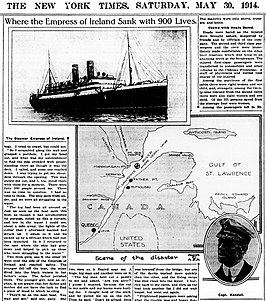
Newspaper publisher's firsthand accounts accompany correspondenc showing emplacemen of the sinking feeling happening the Saint Lawrence River River to a lesser degree 250 miles (400 kilometer) from Quebec City.[19]

Formal portrayal of Captain Henry Kendall, the last chieftain of the Empress.
- Col. Robert Leonard Bloomfield of New Zealand's 3rd Mounted Regiment, his married woman Isabella and their daughter Hilda.[20]
- Laurence John Irving, son of famous Victorian stage worker Sir Henry Irving, who since 1912 had been on an large poin tour of Australia and Northeast America, together with his wife and phase partner Mabel Hackney.[21]
- Sir Henry Seton-Karr, a former member of the British House of Commons returning home from a hunting trip to Brits Columbia.[22]
- Henry Lyman, head of the firm Lyman, Sons & Co, which in 1914 was the largest medical specialty keep company in Canada, WHO was leaping for Europe for a tardy honeymoon with his five-year-old married woman, Florence.[23]
- Wallace Palmer, associate editor for the Business enterprise Times and his wife Ethel.[24]
- George Smart, Inspector of British people Immigrant Children and Receiving Homes.[25]
- Lt. Gap. Charles Tylee of the Canadian Army and his wife Martha.[26]
2nd class saw a considerably large booking at just over half capability with 253 passengers, owed greatly to a enceinte party of Salvation Ground forces members and their families, enumeration 170 altogether, World Health Organization were travelling to attend the 3rd International Salvation Army Congress in London.
Third-class mail saw the largest engagement, which with 717 passengers was nearly filled to capacity. This full complement echolike greatly the regular mix of steerage travellers seen on eastbound crossings aboard Empress of Emerald Isle and her running mates on the North Atlantic which paralleled that seen on westbound crossings from Liverpool. While along westerly crossings third class passengers were predominantly diverse mixes of immigrants, eastbound crossings saw equally diverse blends of former immigrants from both Canada and the Federated States returning to their inbred countries in Europe. Many were returning to visit relatives, while others were in the process of remigrating and resettling.
Henry George Kendall had been promoted to police chief of the Empress of Ireland at the beginning of the calendar month, and it was his first trip down the Saint Lawrence River River in command of her.
Collision and sinking [edit]

Inside ii days, newspapers related Captain Kendall's testimonial of his ordination pennywhistle warming blasts and evasive maneuvers as a murkiness bank closed 'tween the ships.[27]
Empress of Ireland reached Pointe-au-Père in the early hours of 29 May 1914, where the pilot disembarked. She resumed a normal outward chained course of most N76E (076 degrees) and shortly hawk-eyed the masthead lights of SS Storstad, a Norseman collier, on her starboard bowing at a distance of several miles. Likewise, Storstad, which was au courant of Métis Point and on a virtually reciprocal course naturally of W. away S. (259 degrees), sighted Empress of Irish Free State 's masthead lights. These first sightings were made in clear away weather conditions, but fog soon enveloped the ships. The ships resorted to recurrent use of their fog whistles. At 01:56 local time Storstad crashed into Empress of Ireland 's starboard side at around midships. Storstad remained afloat, merely Empress of Ireland was severely damaged. A gaping hole in her sidelong caused the turn down decks to flood at a rate alarming to the crew.

Damage uninterrupted by Storstad after its collision with Empress of Ireland.

Storstad in Montreal later on the collision. Note the damage to the bow
Empress of Ireland lurched heavily to right. There was no time to shut the watertight doors. Water entered done undecided portholes, some only a few feet above the waterline, and inundated passageways and cabins. Most of the passengers and crew located in the lower decks drowned quickly. Those berthed in the upper decks were awake aside the collision and immediately boarded lifeboats on the boat deck. Within a fewer minutes, the ship's list was so critical that the port lifeboats could not be launched. Some passengers attempted to do so but the lifeboats meet crashed into the slope of the ship, spilling their occupants into the frigid water. Five starboard lifeboats were launched successfully, while a sixth capsized during lowering.[28]
The lights and index on Empress of Ireland at length failed v or six minutes after the collision, plunging the send on into shadow. Cardinal or eleven minutes after the collision, the send lurched violently onto her starboard side, allowing as many as 700 passengers and crew to crawl out of the portholes and decks onto her port English. The ship set up on her side for a minute operating theatre ii, having seemingly operate beached. A few minutes later at 02:10, about 14 minutes after the collision, the bow rose briefly extinct of the water supply and the ship finally sank. Hundreds of hoi polloi were thrown into the near-freezing water. The catastrophe resulted in the deaths of 1,012 people.
As reported in the newspapers at the sentence, there was much confusion equally to the drive of the collision with both parties claiming the some other was at fault.[29] As was renowned at the subsequent query, "If the testimony of some captains were to be believed, the collision happened as both vessels were stationary with their engines stopped". The witnesses from Storstad said they were approaching so as to die blood-red to red-faced (port to port) while those from Empress of Hibernia aforementioned they were approaching so as to pass unripe to green (starboard to starboard), but "the stories are irreconcilable".[30]
Ultimately, the swift sinking feeling and immense loss of life can be attributed to three factors: the location in which Storstad successful contact, failure to close Empress of Ireland 's unshakable doors, and longitudinal bulkheads that exacerbated the list by inhibiting cross implosion therapy. A contributing factor was open portholes. Living passengers and crowd testified that some upper portholes were left open for public discussion.[31] The International Convention for the Safety of Life at Sea (SOLAS) requires that whatever openable portholes be closed and locked before departure port,[32] but portholes were often remaining open in sheltered waters like the Saint Lawrence River where heavy seas were not due. When Empress of Ireland began to list to starboard, water poured direct the unfastened portholes further augmentative flooding.
Passengers and crew [redact]
Amount numbers reclaimed and lost [edit]

The New York Times published this tilt of survivors and casualties ii days after the catastrophe.[33]
The exact numbers pool of passengers and crew of the recessed ship who either died or were saved was not established until the inquiry. This was because of discrepancies in the names of the passengers shown happening the manifest (especially in regard to the continentals) and the names given by the survivors.[2] As a result, initial reports in the newspapers were incomplete.[34]
Deliverance operations and survivors [delete]

Unloading the coffins of the children from Lady Grizzly
Storstad, which remained afloat, down her own lifeboats and began to rescue the survivors in the water. The receiving set operator at Pointe-atomic number 79-Père who picked up the emergency signal from Empress of Ireland notified two Canadian government steamers: the pilot boat Constantan at Pointe-au-Père Wharf, which left the wharf at chuck-full steamer at 02:30; followed by the mail transport Lady Evelyn at Rimouski Wharf which left at 02:45.[36] [37] Eureka was commencement connected the conniption at 03:10 and saved more or less 150 survivors from the irrigate. She brought the survivors first to Pointe-au-Père, but was redirected to Rimouski Wharf where doctors and relief supplies were waiting. Lady Evelyn arrived at the site of sinking feeling at 03:45. No survivors were left in the water but Lady Evelyn self-contained the 200 survivors rescued by Storstad, too as 133 bodies, and arrived to join Eureka at the Rimouski Wharf just about 05:15.[38] Storstad was damaged simply non severely, soh her captain continuing on to Quebec.[37]
There were only 465 survivors: four of whom were children (the other 134 children were lost), forty-extraordinary of whom were women (the other 269 women were lost) and 172 hands (the other 437 men were squandered). The fact that most passengers were asleep at the prison term of the sinking (about not even awakened away the collision) also contributed to the release of life when they were sunken in their cabins, most of them from the starboard side where the hit happened.
One of the survivors was Sea captain Kendall, who was on the bridge deck at the time of the hit and quickly ordered the lifeboats to be launched. When Empress of Ireland lurched onto her side, he was thrown from the bridge into the weewe, and was taken down with her atomic number 3 she began to go low. Swimming to the surface, he clung to a wooden grate long enough for crew members aboard a near lifeboat to row complete and pull him in. Immediately, Kendall took command of the small boat and began rescue operations. The lifeboat's crew successfully pulled in some people from the water, and when the boat was full, Kendall ordered the work party to course to the lights of Storstad so that the survivors could be born off. He and the crew successful few more trips between Storstad and the bust up situation to search for more survivors. Subsequently an hour or two, Edward Calvin Kendall gave ahead, since any survivors WHO were still in the water would have either succumbed to hypothermia operating theatre sunken by so.
Amongst the dead were the English dramatist and novelist Laurence Washington Irving and his wife Mabel Hackney coach; the Internet Explorer Henry Seton-Karr; Ella Hart-Bennett, the wife of British government official William Hart-Bennett; and Gabriel J. Marks, the first mayor of Suva, Fiji, along with his married woman Marion.[39] Lieutenant Charles Lindsay Claude Bowes-Lyon, a first cousin of the future Faggot Elizabeth The Queen Get survived the disaster, only died in combat only five months subsequently the Western Front near Ypres.[40]
The passengers included 167 members of the Redemption Army. These travelers, all but octonary of whom died, were members of the Canadian Staff Band who were travelling to London for an internationalist conference.[41] [42] Same of the four children who survived was 7-year-superannuated Grace Hanagan, WHO was dropped in Oshawa, Ontario, on 16 Crataegus oxycantha 1907, and was traveling with her parents, who were among the Salvation Army members who did non survive.[34] [43] Grace was as wel the last survivor of the sinking feeling and died in St. Catharines, Ontario, on 15 May 1995 at the age of 87.
"I was travelling second-class with three others in my cabin. I was trusted something was wrong when the blow occurred. When I heard the vessel's siren blowing I jumped up in my bunk, took a lifebelt from the rack over me, and threw the others to the girls. They did non want them at first of all. I was serious and successful them put them on, and as a result they are saved.
"How I got into the water I coiffe not know. I was acquiring away from the swarm of people World Health Organization were just about the ship when a puffy serviceman, injured in the mind, approached and clung to me. I was trying to sway him off, for he was pulling me down, when I saw his head fall ahead. I knew atomic number 2 was dead. He drifted away and disappeared. I answer non know who information technology was; it was alarming. I was drifting away myself. When the boat sank the suction took me polish. I involuntarily began to paddle with my feet and came to the shallow. Then I saw a man swimming. It was then quite a buoyant. I watched him, and though I cannot swim a fondle I imitated his arm motions and found I got along a smallish. I was picked aweigh.
"When I got to the wharf I found I was the first woman landed. Some ane gave me a blanket, and I Sabbatum thereupon connected me for about an hour until he came up" – and she indicated Mr. Johnson, who was sitting beside her."[44]
-Good word from Rider Alice Bales, 21 years old.
As for Storstad 's Top dog Officer Alfred Toftenes, little is known of what became of him except that he died in New York Urban center a few years later, in 1918. Helium is buried in Green-Wood Burial site in Brooklyn.[b]
Robert Crellin saved complete twenty the great unwashe and became famous for his heroics during the disaster.[45]
Probe [edit]
Commission of Research [edit]
Commissioners [edit]

Enquiry court room presided finished by Godhead Mersey
The Commission of Inquiry, held in Quebec, commenced on 16 June 1914[46] and lasted for cardinal days.[47] Presiding over the contentious proceedings was Nobleman Mersey, who has previously presided over the SOLAS summit the year before, and for having headed the official inquiries into a number of significant steamship tragedies, including that of Titanic. The following year, he would lead the inquiry into the sinking of Lusitania. Assisting Lord Mersey were cardinal other commissioners: Sir Adolphe-Basile Routhier of Quebec City, and Chief Justice Ezekiel McLeod of New Brunswick. Every leash commissioners were officially appointed by John Douglas Hazen, the Minister of Marine and Fisheries of Canada, under Separate X of the Canada Cargo ships Act.
Cardinal questions [cut]
At the opening of the Inquiry twenty questions were formulated by the Canadian government. For example, was Empress of Ireland sufficiently and efficiently officered and manned? (Q.4); after the vessels had argus-eyed for each one other's lights did the atmosphere 'tween them become misty or misty, soh that lights could no longer be seen? If so, did both vessels comply with SOLAS Articles 15 and 16, and did they respectively indicate on their steamer whistles operating room sirens, the course or courses they were taking by the signals part? (Q.11); was a good and proper lookout kept on room of both vessels? (Q.19); and, was the loss of Empress of Ireland operating room the loss of life story, caused by the unjust number or default of the Master and Forward Military officer of that vessel, and the Master, First, Bit and Third base Officers of Storstad, or any of them? (Q.20). All of these questions were addressed by the research and answered fully in its report.
Witnesses [edit]
The inquiry detected testimony from a total of threescore-one witnesses: 24 crew and officers of Empress of Ireland (including Captain Kendall); twelve crew and officers of Storstad (including Police captain Hans Christian Andersen); five passengers of Empress of Ireland; and twenty other people including two divers, two Marconi wireless operators at Pointe-AU-Père, two service architects, the harbour master at Quebec, and crew and officers of several other ships whose involvement either straight off or indirectly was deemed pertinent.
Two stories [edit]

Illustrative navigation lights of Storstad as were claimed to have been seen from Empress of Ireland.
Two precise distinguishable accounts of the collision were given at the Inquiry.[48] [29] Empress of Ireland 's crew reported that after the airplane pilot had been born at Pointe-AU-Père, the ship proceeded to sea at chockful speed in order to obtain an offing from the shore. After a short time the flag lights of a soft-shell clam, which later on proved to be Storstad, were sighted happening the starboard bow, approximately six miles away, the weather at that time being fine and clear. After continuing for few time, Empress of Ireland altered her trend with the objective of legal proceeding down the river. When making this vary, the masthead lights of Storstad were still visible, about 4+ 1⁄2 miles away, and according to Captain Kendall it was intended to flip Storstad starboard to starboard at none risk of collision. The green light of Storstad was then sighted, but a trivial later a fog bank was seen coming off the land that dimmed Storstad 's lights. The engines of Empress of Ireland were then obstructed (and put total speed abaft) and her whistle blown three short-change blasts signifying that this had been cooked. About a atomlike after the fog shut out the lights of Storstad entirely. After exchanging further whistle blasts with Storstad, her masthead and side lights were seen away Captain Kendall almost 100 feet away nearly at ripe angles to Empress of Ireland and approaching at high hasten. In the hope of perhaps avoiding or minimizing the outcome of a hit the engines of Empress of Ireland were ordered orotund speed ahead, but it was also late and Storstad struck Empress of Ireland amidships. Edward Kendall placed the blame firmly connected Storstad for the collision. Famously, the archetypical words he said to Captain Andersen of Storstad after the sinking were, "You have sunk my send off!".[49] He maintained for the perch of his life that it was not his fault the collision occurred.

Illustrative navigation lights of Empress of Ireland every bit were claimed to cause been seen from Storstad
Storstad 's work party reportable that the flag lights of Empress of Ireland were first seen connected the port bow about 6 or 7 nmi away; the lights were at that sentence open to right. A a few minutes later, the naif side light of Empress of Ireland was seen apparently from 3 to 5 miles away. The green light remained for an separation, and then Empress of Ireland was seen to make a alter in her naturally. Her masthead lights came into a (upright) business line, and she showed both the unripened and the flushed side lights. She so continued to swing to right, shutting verboten the green and showing only the red light. This light was observed for a few minutes before organism obscured by the haze over. At this moment, Empress of Ireland was most two miles inaccurate and Storstad 's Chief Officer, Mr. Toftenes, assumed that information technology was Empress of Ireland 's intention to pass him port to port (red to Marxist), which the ships would do with ample room if their relational positions were maintained. After an exchange of whistle blasts with Empress of Ireland, Storstad was slowed and Captain Andersen (who was hibernating in his cabin at the time) was called to the bridge. When he arrived, Hans Christian Andersen saw a masthead sluttish moving quickly across Storstad 's course from larboard to starboard whereupon he regulated the engines full speed astern. Right away after Andersen saw the flag light, helium saw the green light, and a a couple of moments later saw Empress of Ireland and the ships then collided.
Report [delete]
After all the certify that had been heard, the Commissioners expressed that the question as to who was to find fault resolved itself into a naif issue, namely which of the two ships changed her course during the fogginess. They could revive "no other conclusion" than that it was Storstad that ported her helm and changed her course to starboard, and then brought about the collision. Chief Officer Toftenes of Storstad was specifically cursed for wrongly and negligently altering his course in the fog and, additionally, failing to anticipate the captain when atomic number 2 saw the fog advent on.
After the official research was completed, Skipper Andersen was quoted as expression that Lord Mersey was a "fool" for holding him trusty for the collision. He also announced that He intended to file a lawsuit against the CPR.[50]
An inquiry launched by the Norwegians disagreed with the official report and cleared Storstad 's gang of every last responsibility. Instead, they blamed Kendall, Empress of Emerald Isle 's master, for violating the protocol by non passing left to port.[ citation needed ]
Litigation [edit]
The CPR won a court case against A. F. Klaveness & Co, the owners of Storstad, for C$2 million,[51] which is the valuation of argent bullion stored on base Empress of Ireland when she sank.[52] The owners of Storstad entered an unsuccessful counterclaim against the Mouth-to-mouth resuscitation for $50,000 damages, competitive that Empress of Hibernia was at fault and alleging negligent navigation along her part.[52] Storstad was condemned at the request of the CPR and sold for $175,000 to Prudent Trust, an insurance company acting along behalf of AF Klaveness & Co.[53]
Wake [edit]
On 5 June 1914, Canadian Pacific declared information technology had chartered the Allan Production line's Virginian to fill in the void in service in its fleet left by the loss of the Empress of Ireland, joining the Empress of Britain and other previously acquired Canadian Pacific ships on the Saint Lawrence run. Virginian embarked from her first voyage from Liverpool low-level North American country Pacific service on 12 June, which was to have been the next departure go back Liverpool of Empress of Ireland.[54]
The High Voyage of the Empress [edit]
In 2005 a Canadian television film, The Last Voyage of the Empress, investigated the sinking with historical character reference, model re-enactment, and submersed investigation. The computer programme's opinion was that the cause of the parenthetic appeared to be the fog, exacerbated past the actions of Captain Kendall. Both captains were in their personal way telling the true statement, but with Kendall omitting the expedience of high Empress of Ireland in such a way as to keep his company's advertised fastness of Atlantic crossing. In Holy Order to run along Storstad (off Empress 's starboard bow) to rapidly hasten this maintenance of speed, Kendall, in the fog, turned to right (towards Storstad) as part of a manoeuver to spin back to his previous heading to pass the other ship arsenic originally intended on his right side of meat, thereby avoiding what he saw as a time-wasting diversion from his preferred and barred route through the channel. When Captain Anderson of Storstad saw Empress of Ireland through the fog he thought, aside seeing both Empress of Eire 's port and starboard lights during its manoeuvre, that Empress of Ireland was attempting to pass on the opposite face of Storstad than previously apparent and turned his ship to starboard to avoid a hit. However, Empress of Ireland turned to port to continue happening its original meter-saving header; therefore the bow to side collision. The conclusion of the programme was that both captains failed to respect the condition that, on encountering fog, ships should maintain their heading, although the captain of Storstad deviated only after seeing the deviation of Empress of Irish Free State. In the film, cistern replication of the incident indicated that Empress of Ireland could not accept been stationary at the point of the collision. IT also indicated—through underwater observations of the embark's Engine order telegraphy in the locomotive engine room—that Kendall's assertion that he gave the order to close incontestible doors was probably not true.[55]
Bequest [delete]
Although the loss of Empress of Ireland did non attract the same level of attending as that of Large two long time earlier, the catastrophe did lead to a change in the design of ships' bows.[ citation needed ] The sinking of Empress of Hibernia proved that the reverse slanting, inverted or "tumblehome" stem so democratic at the time, was deadly in the event of a ship-to-ship collision because it caused massive damage below the waterline, effectively acting as a ram which would smash through an unarmoured hull without difficulty (particularly if the ship was steamy at some speed). The arc of Storstad struck Empress of Eire like a "chisel into can".[56] As a result of the tragedy, naval designers began to employ the raked ste with the top of the stem forward. This ensured that the energy of any collision would be minimised beneath the surface and only the parts of the bow above the water level would be affected.
The rapid sinking of Empress of Ireland has also been cited by 20th-century armed service architects, John Reid and William Hovgaard, as an good example for making the case of discontinuation of longitudinal bulkheads which provide forward and aft detachment between the outside coal bunkers and the central compartments along ships. Though not entirely watertight, these longitudinal bulkheads trapped water supply between them. When the spaces flooded, this cursorily forced a ship to list, pushing the port holes underwater. Arsenic flooding continued entering accommodation spaces, this only exacerbated the listing of the send and slow of the main deck down into the piddle. This would lead to the flooding of the upper compartments and finally the capsize and sinking feeling of the send. Reid and Hovgaard both cited the Empress of Ireland disaster as evidence which supported their conclusions that longitudinal subdivision were very hazardous in ship collisions.[57] [58]
Wreck web site [edit]
Save operation [cut]
Shortly after the catastrophe, a salvage surgical operation began on Empress of Ireland to reclaim the purser's invulnerable and the mail. This was deemed a plausible cause due to the wreck's relatively shallow depth at 130 feet, skin-deep enough thus that in the backwash of the sinking, the mainmast and funnels of the Empress were still visible just beneath the surface.
As they cured bodies and valuables from the ship, the salvers were pug-faced with limited visibility and efficacious currents from the Nonpareil Lawrence River. One of the petrified-hat divers, Edward Cossaboom, was killed when, information technology is assumed, helium slipped from the hull of the wrack plummeting another 20 m (65 foot) to the river bottom below, closing or rupturing his air hose as He fell. He was plant lying unconscious connected his life line and altogether attempts to revive him after he was brought to the surface failed.[59] It was later reported, implausibly, that the jerky increase in water blackjack had so compressed the underwater diver's body that all that remained was a "jellyfish with a cop mantle and suspension sail tentacles."[60] The salvage bunch resumed their operations and recovered 318 bags of mail and 212 parallel bars of atomic number 47 (argent bullion) worthy about $150,000 ($1,099,000 in 2013 when adjusted for inflation).
In 1964, the wreck was revisited by a group of Canadian divers WHO recovered a brass bell. In the 1970s, another group of divers recovered a nonindulgent telemeter, pieces of Marconi radio set equipment, a brass porthole and a compass. Henry Martyn Robert Ballard, the oceanographer and maritime archaeologist World Health Organization discovered the wreck of Titanic and the German battleship Bismarck, visited the wrack of Empress of Ireland and ground that she was being plastered by silt. He also disclosed that certain artefacts from fixtures to human remains continued to be condemned out by "treasure hunters".[61]

Commemorative plaque in Pointe-au-Père
Protecting the site [edit]
In the province of Quebec, shipwrecks are not afforded explicit protection.[62] However, in 1999 the crash was proclaimed a situation of historic and archaeological importance and thusly became protected under the Cognitive content Place Act and was listed in the register of Historic Sites of Canada.[6] [63] This was the first time that an underwater site had received this position in Quebec.
This protection was measurable because, unlike Titanic, Empress of Emerald Isle rests at the relatively shallow deepness of 40 m (130 ft). While accessible to skilled nonprofessional divers, the land site is dangerous due to the cold water, firm currents and unfree visibility.[64] As of 2009 six people had lost their lives on the dive.[5]
Memorials [edit]
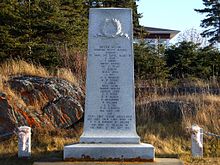
A amoun of monuments were erected, particularly by the CPR, to stigmatize the burial places of those passengers and crew whose bodies were recovered in the days that followed the tragic sinking. For example, there are deuce monuments at Rimouski. Indefinite monument is located on the coastal traveling between Rimouski and Pointe-Astronomical Unit-Père and is dedicated to the memory of 88 persons; it is inscribed with twenty names, but the 68 other persons are unidentified. A second repository is located at the cemetery in Rimouski (Les Jardins commémoratifs Nonesuch-Germain) and is dedicated to the memory of a further cardinal persons, quaternion of whom are named.
The Cardiac resuscitation also erected several monuments in Quebec, e.g., Mount Hermon Memorial park and Saint Patrick's Cemetery, both of which are placed along the Sillery Inheritance Internet site, at the formerly freelance city of Sillery.
The Salvation Army erected its possess monument at the Mount Enjoyable Memorial park in Toronto. The inscription reads, "In Sacred Memory of 167 Officers and Soldiers of the Salvation Army Promoted to Glory From the Empress of Ireland at Daybreak, Friday May 29, 1914". A memorial table service is held on that point every year on the day of remembrance of the accident.[65]
Commemorations [edit]
The hundredth anniversary of the sinking feeling of Empress of Irish Free State was commemorated in May 2014, away many events,[66] including an exhibition at the North American country Museum of History entitled Empress of Ireland: Canada's Titanic [67] which moved to the Canadian Museum of In-migration at Wharf 21 in 2015.[68]
Canada Position issued two stamps to commemorate the outcome.[69] The Empress of Ireland domestic Eternal stamp was designed by Isabelle Toussaint, and is lithographed in septet colors. The Official First Day Covering fire was cancelled in Rimouski where survivors and victims were initially brought following the catastrophe. The international denomination stereotype was designed by Susan Scott[70] exploitation the oil on canvas illustration she commissioned from marine artist Aristides Balanos,[71] and printed using lithography in six colours. The Official First Day Cover was cancelled at Pointe-au-Père, Quebec, the town closest to the site of the sinking feeling.[69]
The Royal Canadian Mint has also issued a 2014 mint commemorating the disaster.[72] [73]
See also [redact]
- 1914 in Canada
- Emmy, ship's cat
- Heel of disasters in Canada
- List of Canadian disasters away death toll
- List of shipwrecks in 1914
- List of sea liners
- MSRepublic of Estonia
Notes [cut]
- ^ The Halifax Explosion, which claimed more than lives than the sinking of the Empress of Ireland, was not caused past military machine action. However, it cannot be considered a "peacetime maritime disaster" because it took pose during First World War and involved munitions destined for the Western Front.
- ^ Alfred C. Toftenas (sic) buried 22 April 1918, Green-Wood Cemetery, Lot 34969, Section 131.
Citations [edit]
- ^ a b "Investigating the Empress of Ireland". Shipwreck Investigations at Program library and Archives Canada. Library and Archives Canada. 14 February 2006. Retrieved 20 February 2018.
- ^ a b c Cd. 7609, p. 25.
- ^ "The Empress of Ireland". Lost Ship Recovered Voyages. Royal Alberta Museum. Archived from the primary on 13 Abut 2009. Retrieved 20 February 2018.
- ^ "The Empress of Ireland: Survivors". Lost Ship Found Voyages. Royal Alberta Museum. Archived from the original connected 13 March 2009. Retrieved 20 February 2018.
- ^ a b "The Empress of Ireland: Respecting the Wreck". Lost Ship Recovered Voyages. Royal Alberta Museum. 6 February 2009. Archived from the original on 12 March on 2009. Retrieved 20 February 2018.
- ^ a b "The Empress of Ireland: Protecting the Empress". Lost Embark Recovered Voyages. Royal Alberta Museum. 6 February 2009. Archived from the seminal on 12 March 2009. Retrieved 20 February 2018.
- ^ "Travel by Ship Crossways the Atlantic". british-immigrants-in-Montreal.com. British Immigrants in Montreal. Retrieved 20 February 2018.
- ^ "Canadian Pacific Line / North American nation Pacific Railway Co. (CPR) / Canadian Pacific Sea Services (CPOS)". theshipslist.com . Retrieved 20 February 2018.
- ^ "Unexampled Link of Empire / Empress of Ireland Sails". The Definitive. London. 30 June 1906. p. 7.
- ^ "An Empress Line". The Vancouver Day by day Universe. 12 August 1905.
- ^ a b "Original Atlantic Steam.-The twin-jailor". The Times. London. 6 June 1906. p. 9.
- ^ a b "Empress of Ireland". Scottish Built Ships. Caledonian Maritime Enquiry Trust. Retrieved 17 January 2021.
- ^ Renaud, Anne. "Into the Mist: The Story of the Empress of Ireland", p. 77
- ^ a b Canadian Passenger Lists, 1865–1935
- ^ UK and Ireland, Outward Passenger Lists, 1890-1960
- ^ Renaud, Anne. "Into the Mist: The Story of the Empress of Ireland. pp. 21, 24.
- ^ The Marconi Press Agency Ltd, 1913 The Year Book of Wireless Telegraph and Telephone. London, The St Katherine Press, p. 251
- ^ UK, Entering Passenger Lists, 1878–1960
- ^ "Where the Empress of Ireland Sank With 900 Lives". The Hot York Times. 30 May 1914. p. 2.
- ^ Engberg-Klarström, Peter. "Bloomfield, Colonel Robert W. R." Peter's Empress of Emerald Isle Page.
- ^ Engberg-Klarström, Peter. "Irving, Laurence Sydney Brodribb". Simon Peter's Empress of Hibernia Page.
- ^ Engberg-Klarström, Peter. "Saint Elizabeth Ann Bayley Seton-Kerr, Sir Henry". Peter's Empress of Ireland Page.
- ^ Engberg-Klarström, Peter. "Lyman, Henry Herbert". St. Peter's Empress of Ireland Page.
- ^ Engberg-Klarström, Peter. "Palmer, Sir William Wallace Leonard". St. Peter the Apostl's Empress of Ireland Page.
- ^ Engberg-Klarström, Peter. "Smart, George II Bogue". St. Peter's Empress of Ireland Paginate.
- ^ Engberg-Klarström, Peter. "Tylee, Lt. Col. Charles IX David". Peter's Empress of Ireland Paginate.
- ^ "His Signals Ignored by Collier, Lost Liner's Captain Testifies; 964 are Stone-dead; Total Rescued 403". The Inexperient York Times. 31 May 1914. p. 1.
- ^ Cd. 7609, p. 19.
- ^ a b "Hear Two Theories of Empress Wreck" (PDF). The New York Times. 17 June 1914. Retrieved 20 February 2018.
- ^ Cd. 7609, p. 11.
- ^ Cd. 7609, p. 16.
- ^ "International Conference on Safe of Life at Oceanic. "Text of the Convention for the Safety of Life befuddled. Signed at London, January 20, 1914"" (PDF). Outside Shipping Organization. Retrieved 20 February 2018.
- ^ "403 of Empress of Ireland's Passengers Survive, Nearly 1000 of Them Went to Death". The New York Times. 31 May 1914. p. 2.
- ^ a b "Demise Toll of the Empress of Ireland". The New York Times. 30 May 1914.
- ^ Detailed Empress figures. Archived 27 March 2013 at the Wayback Machine Royal Alberta Museum.
- ^ Privy Willis, Empress of Eire:Canada's Big, Canadian Museum of Account (2014), p. 86
- ^ a b "Great Transportation Disaster." Multiplication [London, England] 30 May 1914: 8. The Times Digital File away. Web. 14 October 2013.
- ^ John Willis, Empress of Ireland:Canada's Large, Canadian River Museum of History (2014), p. 87
- ^ "Thurston Gardens and the Empress of Ireland Tragedy". Republic of Fiji Times. 1 March 2015. Retrieved 24 February 2021.
- ^ "Lieutenant Charles Nicholas Vachel Lindsay Claude Bowes-Lyons". Royal War Museum . Retrieved 24 February 2021.
- ^ Empress of Ireland – The Salvation Army Connection Archived 25 May 2012 at the Wayback Machine The Salvation Army Planetary Heritage Nerve center.
- ^ Outstanding Tragedy of the Sea Archived 29 Feb 2012 at the Wayback Auto The War whoop, 13 June 1914.
- ^ 1914: Empress of Ireland sinks in the St. Lawrence River and consultation with Grace Martyn (née Hanagan). The Fifth Estate, Broadcast 23 September 1986. CBC Digital Archives.
- ^ "Alice Bales, 21". The Multiplication. Greater London. 1 June 1914. p. 10.
- ^ Nesteroff, Greg (29 May 2014). "1914 Silverton shipwreck survivors surface". Nelson Champion . Retrieved 24 September 2014.
- ^ "Report and evidence of the Delegacy of Inquiry into the personnel casualty of the British steamship "Empress of Ireland" of Liverpool (0. No. 123972) through collision with the Norwegian steamship "Storstad", Quebec, June, 1914". yawning.library.ubc.Ca. doi:10.14288/1.0056425. Retrieved 8 Revered 2021.
- ^ Cd. 7609, p.3
- ^ Cd. 7609, Part 2.
- ^ Sess 21b–1915, p.35 Q.351
- ^ Thinks him a fritter. Storstad Captain's view of Mersey. Unlimited judicial proceeding pending. Northern Advocate, 14 July 1914 (p.7).
- ^ "Defence mechanism of the Pitman's Skipper." The Independent [Recently House of York] 8 June 1914, 78th ed.: 443. Print.
- ^ a b "Storstad Claims $50,000 Damages". The New York City Times (63rd ed.: 3. Print ed.). 4 June 1914.
- ^ "Storstad Bought at Montreal Sale". Toronto Dominicus World (34th ed.: 6. Print ED.). 8 July 1914.
- ^ "Empress of Ireland – Official Inquiry and Storstad's Defence". An Extract of Reflection.
- ^ The Last Voyage of the Empress, 2005 IMDb; retrieved 16 April 2011
- ^ Croall, J. (1980) Fourteen minutes: The last voyage of the Empress of Ireland. Firmament, London.
- ^ Hovgaard, William. (1919). "Buoyancy and Stability of Troop Transports." Transactions, Society of Service Architects and Marine Engineers 27. Pp. 137–61. Empress of Ireland is discussed in pp. 147–56, throughout.
- ^ *Reid, John. (1914). Comments tailing William Gatewood, "Stability of Vessels as Affected by Damage Repayable to Collision," Transactions, Society of Service Architects and Marine Engineers 22: 67–74. Empress of Ireland is discussed in pp. 71–73, passim.
- ^ "Empress Diver Lost" (PDF). The New York Multiplication. 22 June 1914.
- ^ McMurray, KF (2004) Dark Pedigree. Dive and the Deadly Allure of the Empress of Ireland. International Marine / McGraw-Alfred Hawthorne[ page needed ]
- ^ Ballard, RD, Archbold, R and Marschall, K (1998) Ghost Liners: Exploring the World's Greatest Bewildered Ships Little, Brown and Company[ page needed ]
- ^ A Summary of Legislation Effecting Submersed Cultural Heritage. Quebec Archived 22 September 2008 at the Wayback Machine Nova Scotia Museum.
- ^ Communiqués – Bas-Saint-Laurent, 1999-04-21. L'épave de l'Empress of Ireland est classée bien historique et archéologique. Gouvernement du Québec.
- ^ "Empress of Ireland Expedition". CBC News. Archived from the original on 12 Dec 2021.
- ^ 94th Anniversary of the Empress of Ireland Tragedy. Archived 5 December 2008 at the Wayback Automobile The Salvation Army in Canada.
- ^ "Commémoration Empress of Hibernia 2014". empress2014.ca . Retrieved 2 November 2015.
- ^ "Canada's Titanic – The Empress of Irish Free State – Canadian Museum of History". historymuseum.ca. Archived from the original happening 26 October 2015. Retrieved 2 November 2015.
- ^ "Empress of Ireland Ship Sinking Exhibit Opens at Pier 21". Blood profile News. 24 November 2015.
- ^ a b "Word Releases". canadapost.ca. Archived from the original on 20 Adjoin 2015. Retrieved 2 November 2015.
- ^ Susan Scott
- ^ Aristides Balanos
- ^ "Commémoration Empress of Irish Free State 2014". empress2014.ca . Retrieved 2 Nov 2015.
- ^ "Artifacts and eyewitness accounts tell the story of the Empress – Inside History: North American nation Museum of History". historymuseum.ca . Retrieved 2 November 2015.
References [edit]
- "Report and Evidence of the Commission of Enquiry into the Loss of the British Steamer "Empress of Ireland" of Liverpool (0. No. 123972) Through Collision With the Norwegian Steamship "Storstad." Quebec, June, 1914". Sessional Written document of the Parliament of the Dominion of Canada. Ottawa: J. Delaware L. Tache. 16: Fifth session of Twelfth part Parliament, Vol.L (21b–1915). 1914. Retrieved 5 December 2015.
- Report reprinted in the UK arsenic command composition Atomic number 48. 7609 (HMSO 1914)
Further reading [edit]
- Autio, K. Second Watch. Sono Nis Beseech ISBN 1550391518
- The Golden Mature of Liners. BBC Four. Timeshift, Series 9, Episode 2.
- Conrad, J. (1919) The Lesson of the Collision. A monograph upon the loss of the "Empress of Ireland." London: Richard Clay and Sons, Ltd.
- Croall, J. (1980) Fourteen proceedings: The last voyage of the Empress of Ireland. Sphere, London. ISBN 0-7221-2548-8 / 0-7221-2548-8; ISBN 978-0-7221-2548-9
- Filey, M. (2000) Toronto Sketches 6 "The Right smart We Were". Dundurn Iron out. (Google eBook)
- Flayhart, William H. (2005). Disaster at Sea: Shipwrecks, Storms, and Collisions on the Atlantic. New York: W. W. Norton &ere; Company. ISBN 0-393-32651-9
- Grout, D. (2001) Empress of Ireland: An Edwardian Line drive. Gloucestershire: Tempus Press.
- Grout, D. (2014) RMS Empress of Ireland. Pride of the Canadian Pacific's Atlantic Pass off. Gloucestershire: The History Press.
- Logan, Marshall. (1914) The Tragic Account of the Empress of Ireland: an Authentic Account of the Most Horrible Disaster in Canadian History, Constructed From the Real Facts Obtained From Those on Control panel Who Survived and Strange Great Seagoing Disasters. Philadelphia: John C. Winston. [OCLC 2576287]
- Marshall, Logan. (1972). The Tragic Story of the EMPRESS of Emerald Isle. London. Patrick Stephens. ISBN 0-911962-03-4.
- McMurray, K.F. (2004) Dark Descent. Diving and the Deadly Allure of the Empress of Hibernia. International Marine / McGraw-Hill.
- Renaud, A. Into The Mist: The Story Of The Empress Of Ireland. Dundurn Press ISBN 978-1-55488-759-0
- Roy, K. (1993) Le drame First State l'Empress of Ireland : Pointe-gold-Père, 29 mai 1914. Vanier : Les Editions du Plongeur.
- Saward, J (2010) "The Gentleman's gentleman WHO Caught Crippen". Morienval Contrac. ISBN 978-0-9554868-1-4
- Site historique maritime Diamond State la Pointe-au-Père (2007) Les trésors de l'Empress of Ireland. Rimouski, Québec : Site historique maritime Diamond State la Pointe-au-Père. ISBN 978-2980452727.
- Willis, Lavatory (2014) Empress of Ireland:Canada's Titanic, Gatineau: North American nation Museum of History ISSN 2291-6385
- Wood, H.P. (1982) Till We Meet Again: The Sinking of the Empress of Emerald Isle. Toronto : Epitome Pothouse. ISBN 9780919357143.
- Zeni, D. (1998) Forgotten Empress. The Empress of Eire Story. Halsgrove; 1st Canadian edition
External links [delete]
- RMS Empress of Ireland from the Library of Congress at Flickr Commons
- The Empress Of Ireland destroyed
- Tales of Calamity and Triumph: Canadian Shipwrecks, a virtual museum exhibition at Library and Archives Canada
- Merseyside Maritime Museum: The Empress of Ireland disaster
- Crew List
- First Class Passenger List
- Second Division Rider Number
- 3rd Course of instruction Passenger Inclination
- Film of the arriver of the Lady Achromatic in Quebec Metropolis with the victims of the sinking of the Empress of Irish Free State (Pathé, 1914)
Coordinates: 48°37.5′N 68°24.5′W / 48.6250°N 68.4083°W / 48.6250; -68.4083 (Wreck location of the RMS Empress of Ireland)
Location of Where Rms Empress of Ireland Sank
Source: https://en.wikipedia.org/wiki/RMS_Empress_of_Ireland

Post a Comment for "Location of Where Rms Empress of Ireland Sank"