Maizie Hirono D hawaii Is Worried About How She Will Ever Get Home Again
Amongst the pivotal moments in Sen. Mazie Hirono's life — one that forced her into heavy introspection — was when her ex-swain and fellow rising star in the Hawaii political sphere proposed to her.
Allison Lynde and she had been together for almost two decades, yet Hirono, D-Hawaii, said she would need time to mull over her decision. At that place was an expectation to "make information technology my primary responsibility to steady him, encourage him, soothe his moods, and smooth his way," she wrote in her new memoir "Heart of Fire." She often took on the part of cheerleader for Lynde, who she recalls had once asked her, "Why haven't you pushed me to greater heights?" while her own wins were interpreted every bit threatening.
"I recollect information technology had more to do with just the dynamics of my relationship with him and the competitiveness that was in our human relationship, which I consider to be a very negative aspect," Hirono, who was 38 years old at the time, told NBC Asian America.
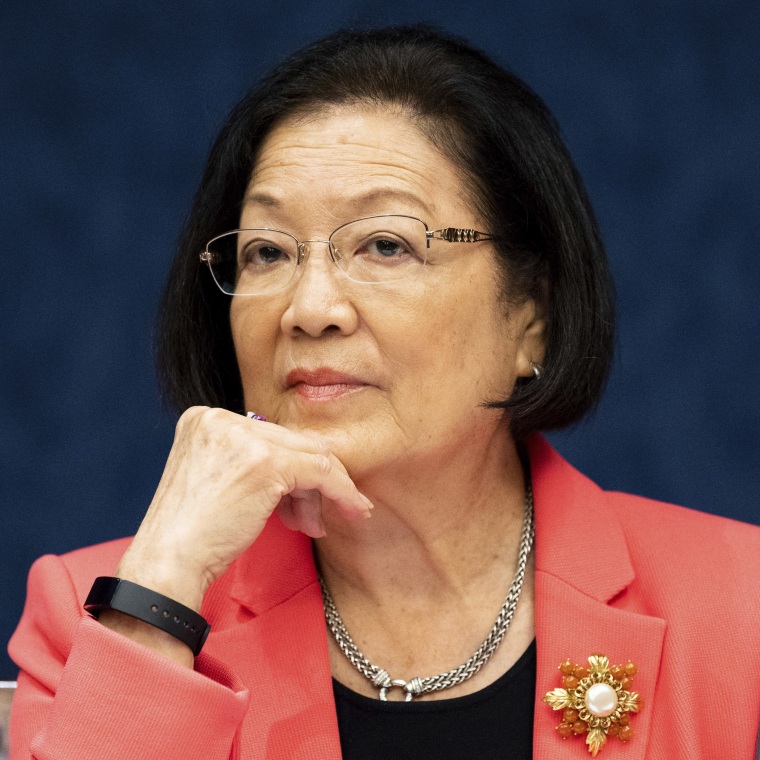
Hirono rejected Lynde's offer, making it ane of many instances in which she's put her pes down in the face up of the double standards women so often face. (She later married Leighton Oshima.)
The senator, the offset Asian American adult female and start immigrant adult female to serve in the Senate, detailed the experience in her book, released last month, and has become known for such candid moments. From telling men to "just shut upwardly and step upwards" and "do the right matter for a change" at a press briefing following the sexual assault allegation against then-Supreme Courtroom nominee Brett Kavanaugh in 2018, to walking out of a hearing that Sen. Ted Cruz, R-Texas, held on antifa final summer, Hirono said she hasn't shied abroad from expressing her emotions. And women in general, shouldn't accept to hold dorsum, she says.
Though many women of Asian descent, in particular, confront cultural constraints that often continue them from speaking out, along with the competing Western expectation that they remain "subservient" or "meek," Hirono, 73, argues that her expression has allowed her to "become more of a complete person."
"Information technology's very helpful if we speak up. Asian women should non be afraid of showing our anger," she said. "When people come across women exhibiting anger, and they'd similar to place the description, such equally 'she's out of command,' information technology doesn't carp me anymore."
Hirono acknowledges this can be difficult for others to embrace, particularly from some Asian immigrants, for whom silence or compliance are sometimes considered the price of admission for stability in the U.s.. But the senator said that she barely felt the weight of such pressures from her own family.
In fact, her development into the brassy, bold political leader she is known to be today began with her mother. A single parent, her mother plotted her escape to Hawaii from Nippon and Hirono's alcoholic, abusive begetter, and didn't brand traditional demands of her girl, Hirono said. Instead, her mother encouraged her to pursue passions or accept on endeavors that were not seen as particularly safety or stable, rather than telephone call on her to get married and settle down.
"I asked her why she was not more vocal about … union. What she said was, 'I ruined my life by getting married to your father, why should I tell you what to practise?'" Hirono explained. "She and I were and so close, that ... I never felt a demand to rebel. This was during the 60s, 70s. And all the kids are rebelling, I never had to rebel against my female parent because she never constrained me."
Early on, Hirono took on pursuits that were considered unusual for Asian immigrants at the time, including protesting the Vietnam State of war — something that fewer than a handful of her classmates did, she said. Simply she wasn't concerned with popularity. Instead, she had to shoulder the burdens of a working class, immigrant household.
"Protesting the state of war was non something I did because information technology was a absurd matter to do. I actually began to question what our country was doing," she said.
Her strong-willed and contained spirit did not make her blind to the racialized sexism that Asian American women so ofttimes confront. Co-ordinate to a study from the call back tank Coqual, formerly known equally the Center for Talent Innovation, about one in four Asian Americans feel out of place at piece of work because of their race or ethnicity. Researchers likewise examined a sense of belonging along race and gender lines. White men had the highest "belonging score," while Asian women exhibited the lowest.
"Clearly, beingness vocal, beingness aggressive, being confrontational were not rewarded behaviors, in my culture, in the Japanese civilisation, and particularly coming from a woman. Then every bit I entered politics, I got things done by being very strategic and knowing what I was talking about," she said. "I really did my homework. That'due south what women do, you know, we pretty much take to hunker downwardly and do all this stuff, because we're not necessarily rewarded for being leaders."
Due to Hawaii'south big Asian American population, Hirono said, racism was non as apparent every bit sexism in her interactions in the state's political scene. However, years subsequently, her status as a trailblazer in the Senate would expose her to colleagues with little feel with Asian Americans and a newer battle emerged.
"I think that they probably have some notions almost Asian people, just generalization that we're all very nice and sweet. And, yous know, nosotros don't make a lot of racket. We work hard," she said of her colleagues in the Senate. "And, and then I don't, I don't call up I comport with that stereotype. ... That's why diverseness is so of import. Information technology broadens your perspective of view."
While much of Hirono's conduct in her career draws from the resilience demonstrated by her mother, there are moments of ache that have defined her, as well. In her book, the senator recounted the scar that the separation from — and later, the death — of her younger brother, Wayne, had on her and her family. Wayne was only 3 years erstwhile when Hirono, her older brother Roy, and her mother moved to Hawaii, temporarily leaving him behind in Japan with her grandparents. She said Wayne would glance at a photograph of the family each day, hoping for their render. Just Hirono wrote that regardless of the happy reunion they eventually experienced, he was forever wounded. This experience was a driving strength in her advancement of family unit reunification.
"His happiness at seeing the states had burned similar the sun, and nevertheless he never again trusted that he would not wake up 1 24-hour interval and find us gone," she wrote. "His emotional wellness remained fragile, his schooling painful, and his life mostly solitary, save for his connection to us."
Though he found reprieve in line-fishing, he drowned one mean solar day when he was 26 years old, the "loss of him to a churning ocean had cleaved us all," Hirono wrote. And while such weighty moments of trauma in Asian civilisation are oftentimes swallowed, held together with the will to forge ahead, Hirono said she had to unearth such emotions to make the instance confronting the Trump administration's "naught tolerance" policy that separated children from parents who were charged with illegal entry at the border. The policy, which has since been rescinded afterward Joe Biden became president, led to the separation of more than 3,000 migrant families.
"I've talked about my younger brother and allow's face information technology, I don't think Asian families, equally a thing of course, showtime talking well-nigh these very personal things," she said. "But I told those stories in a very purposeful context of family separation, and and then many of my lived experiences relate to the things that nosotros are having to face."
Particularly in today'southward climate, when many Asian Americans are on the receiving end of the anxiety and blame amidst the pandemic, the act of speaking out can feel enormous. Just she affirms that "to stand our footing is to get more fully ourselves."
"There have been many times in my life where I idea, 'You should say something,' then I will agree back. So I try not to listen to that kind of vocalism so much anymore," Hirono said. "I'g non maxim nosotros should turn into these really obnoxious, hateful, assholes. Only ... through my journeying, I've become more than fully myself by exercising my song cords, and non simply my brains and my center."
Source: https://www.nbcnews.com/news/asian-america/sen-mazie-hirono-hawaii-doesn-t-care-if-you-think-n1267818

Post a Comment for "Maizie Hirono D hawaii Is Worried About How She Will Ever Get Home Again"